
How the Swift County Court Calendar Works
The court's official page posts something called the Weekly Public Court Calendar. Despite the name, the link opens a daily calendar PDF. Think of it as the working snapshot of Swift County District Court hearings. It goes up at 7:00 a.m. each business day and gets refreshed hourly. Judges get swapped. Courtrooms shift, and cases move. So a calendar line never equals the full register of actions.
Confidential and non-remotely accessible cases stay off the PDF. So a missing line does not mean a hearing was cancelled, continued, or never set. Printed calendars hang outside the courtrooms and in the public lobbies. The courthouse calls those the most current daily version. For filings, case history, and deeper hearing work, pair the PDF with Minnesota Court Records Online, or MCRO.
Note: A calendar covers one day's scheduling. The register of actions logs a case's procedural activity over time.
Swift County Daily Calendar Updates
Swift County refreshes its court schedule every hour. Save a copy in the morning. It may not match what you see at noon. Room numbers, judicial officers, and hearing formats can all shift during the day. Before you head out, pull the official daily calendar PDF one more time near your hearing hour. Anything still unclear should go straight to court administration.
The Eighth Judicial District includes Swift County along with several other county district courts. The district office does not hear the local cases, though. Swift County District Court posts the local calendar and answers calendar questions.
The Eighth Judicial District's official court information shows the wider district court setting. That context helps you see how the Swift County calendar fits in.
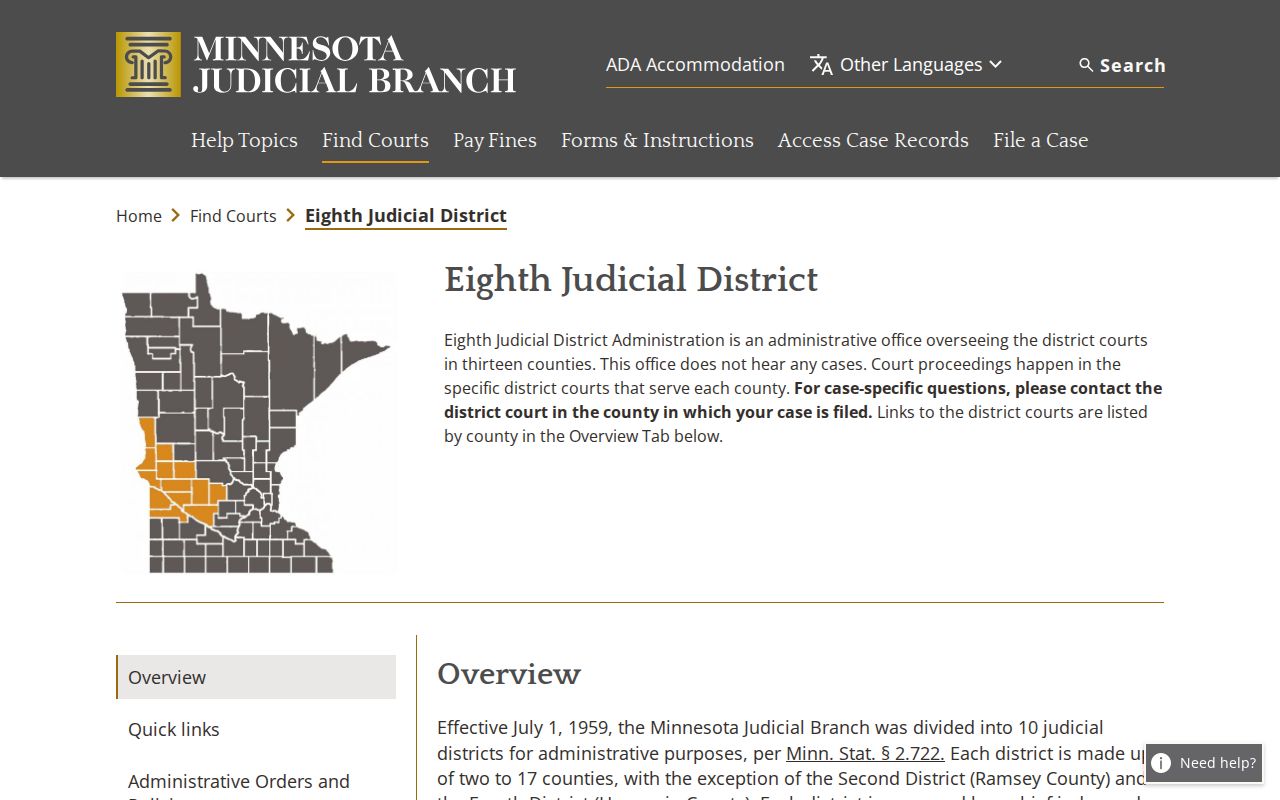
The district overview is helpful background. For a particular local hearing, the Swift County daily calendar is still the source that counts.
Swift County Court Date Lookups
Want to confirm a Swift County court date? Take it one step at a time. The daily PDF shows what a single day holds. For anything wider, MCRO's Hearing Search covers hearings by name, case number, judicial officer, or attorney across a chosen date range. Those tools answer the schedule question. Attendance directions are a separate matter, so rely on the case direction the court or your lawyer provided. A listing on its own is not an instruction to appear, and one source alone never replaces the court's own notice.
- Open the official daily calendar and look for the date, time, hearing location, and hearing type.
- Use MCRO Hearing Search by name, complete case number, judicial officer, or attorney when broader hearing detail is needed.
- Compare the results with the case record and any notice already issued in the matter.
- Call Swift County District Court Administration at 320-843-2744 to confirm a time, courtroom, or connection arrangement that remains unclear.
- At the courthouse, check the public lobby or courtroom posting because the court identifies that printed calendar as the most current version.
Need to know whether you must show up? A lawyer on the case is a documented channel for that kind of question. Court administration handles the local calendar details. A lawyer can speak to what a specific case needs. Use the statewide search and the daily PDF as public tools. Neither one replaces those two direct routes.
Swift County PDF and MCRO Hearings
The Swift County PDF and MCRO do different work. Think of the PDF as a short-lived snapshot built for the court day itself. MCRO goes wider. It offers four tabs: Case Search, Document Search, Hearing Search, and Judgment Search, and it can show more of an eligible case or hearing record. If you are tracing a hearing from the calendar back into a case file, the Swift County Docket Search route explains the search modes that are open to you.
| Source | Best use | Important limit |
|---|---|---|
| Swift daily PDF | Today's scheduled hearing details | Changes hourly and omits confidential or nonremote matters |
| MCRO Hearing Search | Search by person, case, judicial officer, or attorney | Remote visibility is narrower than all courthouse access |
| Printed courthouse calendar | Current local schedule at the building | It does not replace a case record or attendance direction |
Note: If the PDF and a broader search seem to disagree, check the current setting with the court. Do not assume either source controls every detail.
Court Settings: What Each Field Means
Each line on a Swift County calendar packs in several answers. You get the party name and the hearing date and time. The location and the judicial officer are there too. So are the hearing type, the connection type, and the case number. Treat all of it as scheduling information. A calendar entry tells you when and where a court event happens, nothing more. It does not report the result of the hearing. It does not give the full contents of the case file or any final outcome in the matter.
| Hearing Date | The scheduled court date for that listed event. |
|---|---|
| Time | The time shown for the calendar setting, subject to same-day changes. |
| Hearing Location | The location shown on the calendar, such as Courtroom 1. |
| Judicial Officer | The officer assigned to the listed hearing. Allison T. Whalen is one observed name in the public calendar structure. |
| Hearing Type | The procedural label, such as arraignment, pre-trial, omnibus hearing, first appearance, conciliation hearing, probate hearing, or intermediate disposition hearing. |
| Connection Type | A role or connection arrangement, not a statement of outcome or complete attendance instruction. |
Take the fields as a set. The case number opens the door to the fuller case record, while the hearing type and location point to the exact setting you still need to confirm.
Swift County Calendar Connection Types
Connection Type gets overread more than any other field. The public calendar labels people as Attorney, Defendant, Petitioner, Plaintiff, or Decedent. A label only names a role or connection arrangement in a calendar entry. It does not reveal why a hearing was set. It also cannot decide whether a person must appear in person. And it never establishes what the court will do.
- Arraignment
- A criminal hearing where a charge is addressed and plea-related procedure may occur.
- Omnibus Hearing
- A criminal pretrial hearing that can address motions or procedural issues.
- Pre-trial
- A setting before trial used for case management or other pretrial work.
- Connection Type
- A calendar field that describes a role or connection arrangement, not a case result.
Statewide hearing changes took effect February 3, 2025. Since then, some Swift County calendar entries carry connection details. Those details do not override case-specific direction. If the docket leaves you unsure whether a hearing is remote or in person, ask court administration or counsel before you rely on the listing.
When a Court Date Moves
Court schedules in Swift County shift more often than people expect. A continuance can move the hearing date, the time, the courtroom, or the judicial officer. The county says as much itself: its daily calendar changes with cases, judges, and courtrooms. So a docket listing that looked right in the morning may be stale by afternoon. Pair the hourly PDF update with the MCRO Hearing Search. Confirm anything critical with the court directly.
One more caution belongs here. A line can vanish from the public PDF. That does not mean the hearing was canceled. Confidential matters and records that cannot be reached remotely never appear on the posted calendar at all. Treat the calendar as a snapshot, not a full attendance ledger. Court administration can answer a local calendar question. The case record adds context when the matter is eligible for remote access.
Swift County Lobby Calendar Check
For the freshest daily calendar, Swift County points to a low-tech source. That source is the printed schedules posted outside courtrooms and in public lobbies. That habit matters when the online PDF was opened hours ago. It also matters when hearings are being shuffled during the day. The courthouse sits at 301 14th Street N., Suite 6, in Benson. Administration keeps doors open Monday through Friday, 8:00 a.m. to 4:30 p.m. It closes daily from noon to 1:00 p.m.
The building itself has history. The court's courthouse history notes the current structure went up in 1898. A clock and carillon were installed later. Age changes nothing about calendar access, though. It simply explains why this courthouse remains the spot for the printed daily posting and in-person records questions.
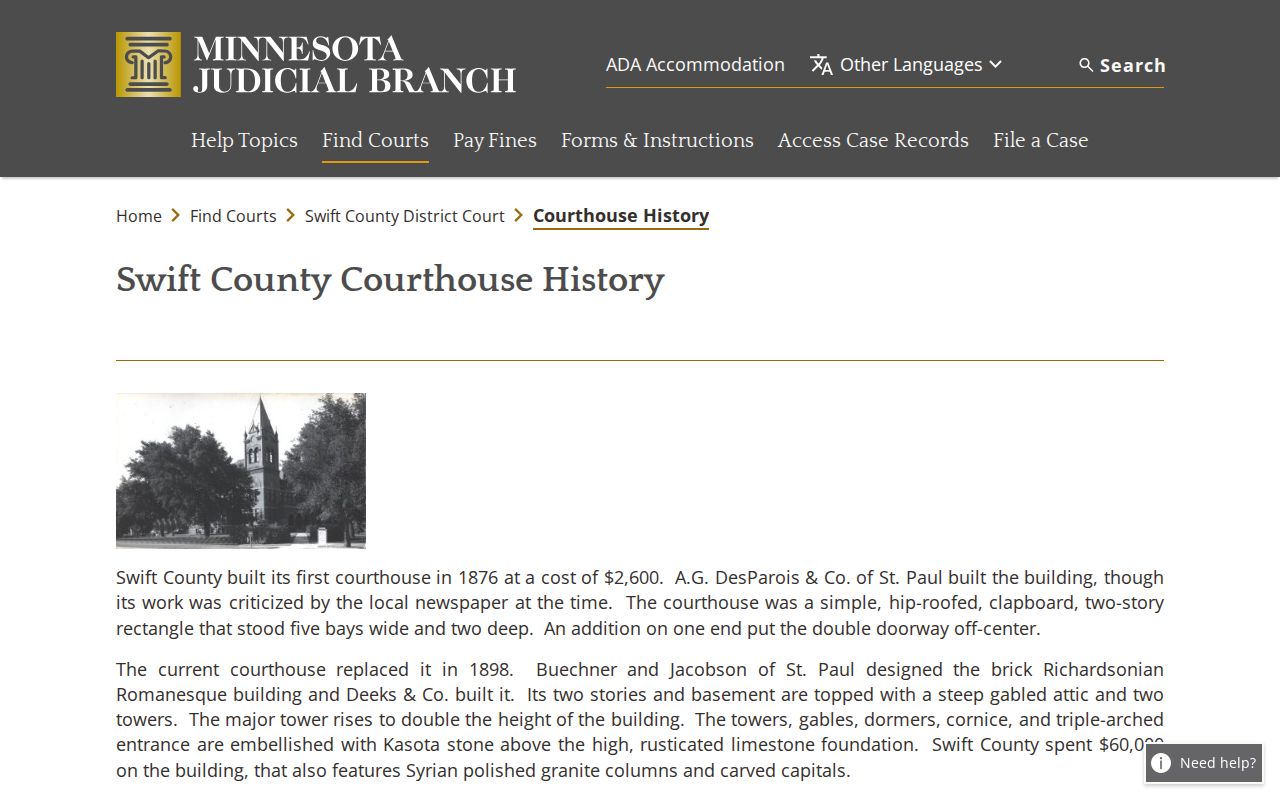
The old courthouse ties two things together. It is where the schedule gets posted, and it houses the administration office that confirms local settings.
Missed Settings and What Comes Next
Think a Swift County court date slipped by? Start by gathering the basics: the case number, the date shown, and any notice received. Include an attorney's contact if there is one. Then call Swift County District Court Administration at 320-843-2744 without delay. A represented person should also reach the attorney. The court can share local calendar information. But the individual case may carry directions no public posting will show.
Missed a Setting? A calendar entry alone does not explain the effect of a missed hearing or the next required action.
Confirm the current status with Swift County District Court Administration and use the complete case number when asking about the setting.
Case-specific legal questions should be directed to a licensed attorney or the appropriate court process.
The daily PDF can help spot the next visible hearing. Still, let the court or your attorney confirm any case-specific instruction.
Swift County Hearing Setting Changes
Minnesota's February 2025 changes to hearing settings are one reason to read calendar connection details with care. A listed connection type may hint at how a hearing will run. It is not a universal attendance rule. Format can turn on the case type, the judicial officer's direction, statewide practice, or exceptions particular to that case.
A solid Swift County court schedule check keeps four questions separate. Is the hearing listed? Has the PDF changed? What does the case record show? And what attendance direction actually applies? That order respects the different jobs done by the daily calendar, MCRO, court administration, and counsel.
Note: Calendar data works best alongside the case number and a current confirmation from the local court channel.